
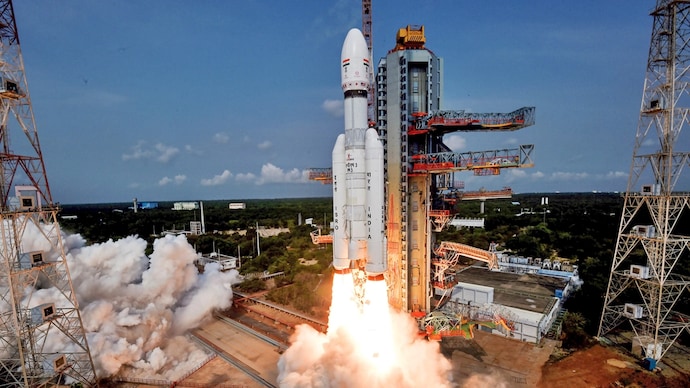
The Indian Space Research Organisation (ISRO) has launched the Chandrayaan-3 spacecraft successfully on 14th July 2023.
- Chandrayaan-3 launched at 2:35 PM IST on July 14, 2023, from the Satish Dhawan Space Center in Sriharikota, Andhra Pradesh.
- The spacecraft was launched by the Launch Vehicle Mark-III (LVM3), and carries a lander and a rover.
- After landing on the surface in August, the rover will then deploy and explore the lunar surface.
- The craft is set to land on the South Pole of the Moon, where Chandrayaan-1 discovered the presence of water molecules.
ABOUT THE MISSION -
- Chandrayaan-3 is India’s third lunar exploration mission, following the Chandrayaan-1 in 2008 and the Chandrayaan-2 mission in 2019.
- The primary objective of the Chandrayaan-3 mission is to demonstrate a soft landing on the lunar surface, which was not achieved in the Chandrayaan-2 mission.
- The spacecraft will include a lander, rover, and propulsion module that will act as a communication relay satellite.
- The propulsion module will carry the lander and rover configuration to the 100 km lunar orbit.
PURPOSE -
- In the lunar orbit, the lander and rover will detach from the propulsion module and make a soft landing on the lunar surface.
- The lander and rover will then carry out scientific experiments on the lunar surface.
- Once Chandrayaan-3 safely lands on the moon, the Pragyan rover will be deployed to explore.
- The rover will be released from Vikram using a ramp. This six-wheeled rover is powered by solar energy and carries two spectrometers to study the composition of the Moon’s surface.
- It will move around the landing area for about 14 Earth days, which is roughly equivalent to one lunar day of sunlight.
ABOUT LAUNCHING VEHICLE -
- The GSLV Mark 3 heavy-lift launch vehicle, also known as the Bahubali rocket, will support the moon lander Vikram.
- The GSLV, now known as Launch Vehicle Mark 3 (LM-3), is 43.5 metres tall. The spacecraft is scheduled to touch down on the moon on August 23 after a voyage that will last more than 40 days.
BENEFITS-
- It represents ISRO’s commitment to pushing boundaries and expanding our understanding of the moon and beyond.
- ISRO aims to mitigate risks and ensure a successful mission, by taking a failure-based approach in its design.
- The mission’s success will further solidify India’s position as a prominent player in the realm of space exploration.
- It has enormous promise for the future of space travel and interplanetary missions.


