
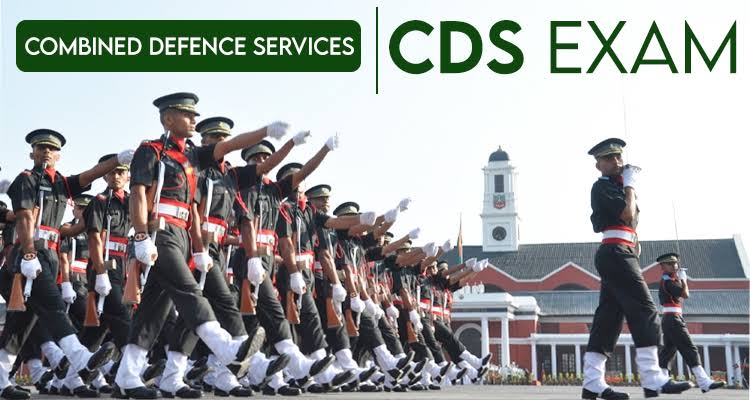
The Union Public Service Commission (UPSC) conducts the "Combined Defence Services" (CDS) Examination twice a year for recruiting candidates for the Indian Military Academy, Officers Training Academy(OTA), Indian Naval Academy(INA) and Indian Air Force Academy(IAF).
The CDS Examination is conducted mainly in two steps - Written test and Interview (SSB).
Successful candidates in written examination are admitted into the respective Academies after an interview conducted by the Services Selection Board ( SSB ).
To clear the examination, first, you need is the complete information of the pattern, syllabus and previous year exam analysis. So that, it would become easy for you to analyse the examination and to prepare a strategy further.
CDS Exam will be conducted in offline mode and there will be Multiple Choice Questions asked in the examination.
WRITTEN EXAMINATION PATTERN
FOR IMA, INA & AFA -
3 PAPERS..
English- 120 Q in 2 Hours
General Ability - 120 in 2 Hours
Maths- 100 Q in 2 Hours
FOR OTA -
2 PAPERS..
English- 120 Q in 2 Hours
General Ability- 120 Q in 2 Hours
[ Negative Marking Scheme: ⅓ of the marks will be deducted for each of the wrong answer. ]
[ Question Paper Language: The question papers (Test Booklets) of General Knowledge and Elementary Mathematics will be set bilingually in Hindi as well as English. ]
WRITTEN EXAMINATION SYLLABUS
[1] ENGLISH
* Spotting Errors Questions
* Sentence Arrangement Questions
* Synonyms & Antonyms
* Selecting Words
* Ordering of Sentence
* Comprehension Questions
* Ordering of words in a sentence
* Fill in the blanks questions
* Idioms and Phrases
[2] GENERAL KNOWLEDGE (GK)
* Economics
* Physics
* Current Affairs
* Politics
* Chemistry
* Sociology
* History
* Defence related Award
* Geography
* Environment
* Sport
* Biology
* Cultural
* Book
* Statement
* true/false
[3] ELEMENTARY MATHEMATICS
ALGEBRA
* Basic Operations
* simple factors
* Remainder Theorem
* H.C.F.
* L.C.M.
* Theory of polynomials
* solutions of quadratic equations
* relation between its roots and coefficients (Only real roots to be considered)
* Simultaneous linear equations in two unknowns—analytical and graphical solutions
* Simultaneous linear inequations in two variables and their solutions
* Practical problems leading to two simultaneous linear equations or inequations in two variables or quadratic equations in one variable & their solutions
* Set language and set notation
* Rational expressions and conditional identities
* Laws of indices
ARITHEMATIC
* Number System: Natural numbers, Integers, Rational and Real numbers.
* Fundamental operations: addition, substraction, multiplication, division, Square roots, Decimal fractions
* Unitary method
* time and distance
* time and work
* percentages
* applications to simple and compound interest
* profit and loss
* ratio and proportion
* variation
* Elementary Number Theory: Division algorithm
* Prime and composite numbers
* Tests of divisibility by 2, 3, 4, 5, 9 and 11
* Multiples and factors. Factorisation Theorem
* H.C.F. and L.C.M.
* Euclidean algorithm
* Logarithms to base 10
* laws of logarithms
* use of logarithmic tables
TRIGONOMETRY
* Sine ×, cosine ×, Tangent × when 0° < × < 90°
* Values of sin ×, cos × and tan ×, for ×= 0°, 30°, 45°, 60° and 90°
* Simple trigonometric identities
* Use of trigonometric tables
* Simple cases of heights and distances
GEOMETRY
* Lines and angles
* Plane and plane figures
* Theorems on Properties of angles at a point
* Parallel lines
* Sides and angles of a triangle
* Congruency of triangles
* Similar triangles
* Concurrence of medians and altitudes
* Properties of angles
* sides and diagonals of a Parallelogram
* rectangle and square
* Circles and its properties including tangents and normals
* Loci
MENSURATION
* Areas of squares
* rectangles
* parallelograms
* triangle and circle
* Areas of figures which can be split up into these figures (Field Book)
* Surface area and volume of cuboids
* lateral surface and volume of right circular cones and cylinders
* surface area and volume of spheres
STATISTICS
* Collection and tabulation of statistical data
* Graphical representation frequency polygons
* histograms
* bar charts
* pie charts etc
* Measures of central tendency
THANKYOU & ALL THE VERY BEST...


